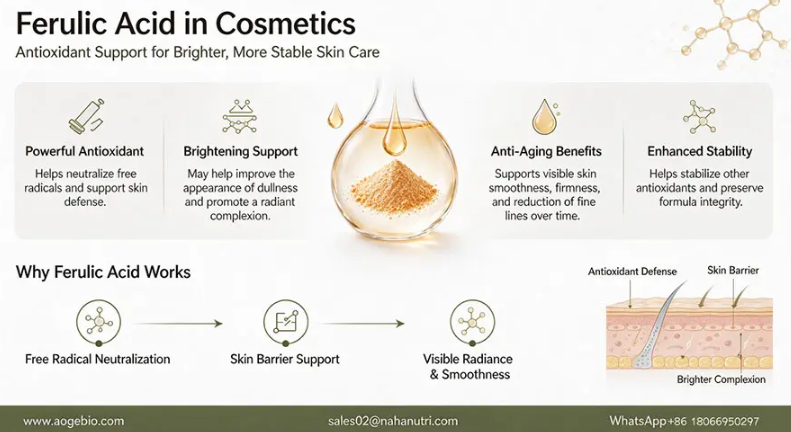
XI’AN, SHAANXI, CHINA, October 26, 2026 /EINPresswire.com/ — If you formulate anti-Aging Skincare, you have almost certainly seenferulic acid on ingredient lists. It is a plant derived phenolic antioxidant found in rice bran, wheat, and oat cell walls, and it has quietly become one of the most studied actives in the anti-aging category. But is it a real selling point for your line, or just a fashionable additive? The short answer is yes and the science, not the marketing, is why. This article explains what ferulic acid does, why formulators keep pairing it with vitamins C and E, where it fits in your product range, and the questions your wholesale buyers will ask before they place an order.
What makes ferulic acid special
Ferulic acid is a small, low molecular weight polyphenol with a conjugated double bond structure and a phenolic hydroxyl group. That structure is exactly what makes it a powerful free radical scavenger. When UV light hits the skin, it generates reactive oxygen species that attack collagen, elastin, and cell membranes. The main drivers of visible aging. Ferulic acid intercepts these radicals and neutralizes them into stable molecules, so it works directly against oxidative stress and photoaging.
Its most valuable property, however, is not its own antioxidant strength but what it does to other antioxidants. In a landmark study published in the Journal of Investigative Dermatology, researchers added 0.5% ferulic acid to a topical solution of 15% L-ascorbic acid and 1% α-tocopherol. The ferulic acid improved the chemical stability of both vitamins and doubled the formulation’s photoprotection of the skin, from roughly 4 fold to approximately 8 fold protection against solar simulated UV radiation (Lin et al., 2005). This is the basis of the now-famous “CEF” combination of vitamin C, vitamin E, and ferulic acid, an antioxidant gold standard that most premium serums build on.
Key product advantages for your brand
First, ferulic acid is a stability booster. Vitamin C is notoriously unstable and degrades quickly when exposed to air and light. Ferulic acid slows that degradation, which means your serum stays effective longer on the shelf and in the customer’s bathroom. Longer stability translates directly into fewer quality complaints and better batch consistency, a practical advantage for any factory or brand owner.
Second, it offers synergy at low cost. Because ferulic acid potentiates the effect of vitamins C and E, you can achieve strong antioxidant performance while keeping active concentrations manageable. In B2B terms, it is a high value, cost friendly way to strengthen a formula, especially when you source it in bulk from a reliable supplier.
Third, it is multifunctional. Beyond scavenging radicals, ferulic acid has been shown to protect dermal fibroblasts from UVA induced damage. In a 2016 study in Annals of Dermatology, pre treatment with ferulic acid protected human dermal fibroblasts against ultraviolet A irradiation (Hahn et al., 2016). It also inhibits matrix metalloproteinase activity, the enzymes that break down collagen, while supporting the synthesis of type I procollagen in dermal fibroblasts, meaning it works on both the “protect” and the “rebuild” side of anti-aging.
Where to use it in your cosmetic line
Ferulic acid is best known as a daytime antioxidant serum ingredient, usually combined with vitamin C and vitamin E. This is its strongest application, because daylight exposure is when oxidative stress peaks and antioxidants are needed most. A daily use CEF serum has become the default recommendation in professional anti-aging skincare routines.
It also fits comfortably into other formats. You can include it in serums, lotions, emulsions, and creams aimed at brightening and evening out tone, thanks to its ability to suppress melanin synthesis and reduce hyperpigmentation. Some formulators add it to sunscreen adjacent products, because it behaves as a mild UV absorber and reinforces photoprotection without replacing the sunscreen itself. In brightening and anti-aging masks, ampoules, and overnight treatments, ferulic acid contributes a stable, photo protective antioxidant base that is well tolerated on most skin types.
Frequently asked questions from buyers
Q: Does ferulic acid need to be paired with vitamin C and E to work?
A: No. It works on its own as an antioxidant. But its strongest, most marketable effect, stabilizing and doubling the protection of vitamins C and E, requires the combination. Most premium formulations use all three because the synergy is well proven.
Q: What is the typical usage concentration in a serum?
A: Around 0.5% to 1.0% is common and effective. Higher levels can be used depending on the formula, but 0.5% already delivers the photoprotection boosting effect shown in the research.
Q: Is it stable and easy to formulate?
A: Yes, and that is one of its selling points. Unlike vitamin C alone, ferulic acid is relatively stable and actually helps stabilize the vitamin C in your formula. Your supplier can provide TDS, MSDS, and COA documentation to confirm batch quality.
Q: Does it have any sensory or compatibility issues?
A: It can have a slight characteristic odor and an acidic pH preference, so formulation should account for buffering and fragrance. This is routine for experienced contract manufacturers.
Q: Can I source it in bulk for manufacturing?
A: Yes. Ferulic acid is widely available as a cosmetic grade raw material. When you buy in bulk from a wholesale supplier, check for assay purity, heavy metal compliance, and a clear certificate of analysis. Confirm INCI listing and regulatory status for your target markets before scale up.
Final word
Ferulic acid is not a passing trend. It is one of the few anti-aging actives whose benefits, free radical scavenging, photoprotection, MMP inhibition, and procollagen support — are documented in peer-reviewed research and its synergy with vitamins C and E is a well established formulation principle. For a brand deciding whether to add it to an anti-aging line, the answer is yes: it raises formula stability, strengthens antioxidant claims, and delivers measurable photoprotection, all at a cost friendly price point when sourced in bulk. Just choose a qualified wholesale supplier, verify your documentation, and test the finished formula for stability and sensory acceptance before launch.
What the research actually says
The evidence base is strong and well cited. The foundational photoprotection study is Lin et al., 2005, in the Journal of Investigative Dermatology (volume 125, pages 826-832). The fibroblast protection evidence appears in Hahn et al., 2016, in Annals of Dermatology (volume 28, pages 740-748). On the matrix metalloproteinase and collagen side, Pluemsamran et al. (2012, Journal of Photochemistry and Photobiology B) showed that ferulic acid inhibits UVA induced MMP-1 through the antioxidant defense system in keratinocytes. A 2018 review by Zduńska et al. in Skin Pharmacology and Physiology summarized ferulic acid’s antioxidant properties and its possible cosmetic applications. A systematic review published in the Journal of Clinical and Aesthetic Dermatology (JCAD) also concludes that ferulic acid is considered beneficial for anti-aging effects due to its anti-inflammatory and antioxidant properties, backed by in vitro, animal, and clinical evidence.
Xi’an Aoge Biotech Co., Ltd.
Xi’an Aoge Biotech Co., Ltd.
Legal Disclaimer:
EIN Presswire provides this news content “as is” without warranty of any kind. We do not accept any responsibility or liability
for the accuracy, content, images, videos, licenses, completeness, legality, or reliability of the information contained in this
article. If you have any complaints or copyright issues related to this article, kindly contact the author above.

Media gallery