SHENZHEN, GUANGDONG, CHINA, September 24, 2026 /EINPresswire.com/ — Engineering an interactive hardware platform requires balancing mechanical precision, optical clarity, firmware tuning, and international regulatory certification before tooling begins. A custom touch screen manufacturer delivers value when electrical, optical, and structural specifications are coordinated as a unified system rather than assembled from disconnected parts. For OEMs and ODMs, standard off-the-shelf panels often introduce design compromises, failing to match custom chassis cutouts, controller firmware requirements, or demanding environmental resistance standards. Custom cover glass dimensions, sensor tailoring, and targeted controller programming ensure reliable operation while meeting international statutory compliance.
Begin with the Equipment Requirement, Not a Standard Panel
Successful custom touch deployment originates with the operational reality of the host machine. Available chassis depth, internal bezel clearances, thermal dissipation paths, display viewing angles, and operator input methods dictate the allowable mechanical footprint. Forcing an arbitrary standard panel into a specialized enclosure frequently causes tooling revisions, delayed schedules, and compromised mechanical sealing during pilot assembly.
Industrial automation terminals demand resilience against coolant splash, airborne oils, aggressive cleaning solvents, and continuous vibration. Outdoor transactional kiosks require optical enhancements and thermal stability against direct solar glare and seasonal temperature shifts. Establishing host device boundaries, operating temperature envelopes, and field service access requirements at the project outset creates a dependable baseline for custom touch screen development.
Match the Touch Technology to the InteractionProjected Capacitive Sensing for Multi-Touch Precision
Touch sensor physics must match the operational workflow of the end user. Selecting between projected capacitive, resistive, or optical architectures determines whether the finished machine operates smoothly under field conditions. Projected capacitive (PCAP) technology provides multi-touch gestures, rapid coordinate tracking, optical transparency, and flat-front glass integration, making it suitable for medical instrumentation, commercial self-service terminals, and interactive retail kiosks. Advanced PCAP controllers utilize mutual capacitance grids tracking up to ten touch points. Digital filtering algorithms suppress electromagnetic noise, maintaining precise coordinate registration even when cover glass encounters moisture or dust.
Resistive and Infrared Solutions for Extreme Workspaces
Resistive touch architectures serve heavy industrial workstations, marine navigation consoles, and agricultural machinery. Operating through physical pressure rather than electrical conductivity, resistive sensors actuate reliably when operators wear thick insulated gloves, work mittens, or use non-conductive styluses, remaining unaffected by fluid droplets, chemical washdowns, or surface grease. Large-format public directories and interactive video walls frequently utilize infrared (IR) touch frames that scale economically over large display areas without adding glass layers that attenuate luminance. Interactive touch foils enable through-glass touch operation for architectural storefronts and secure kiosks, guiding system architects toward the physical mechanism that best serves the target interaction model.
Define the Customization Stack as One System
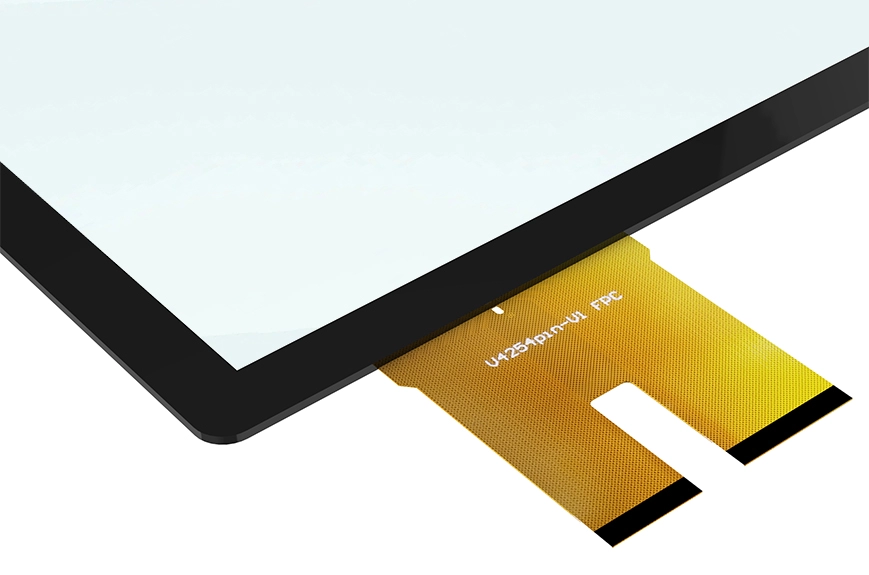
A high-reliability touch module operates as an integrated multi-layer stack comprising cover glass, sensor substrate, flexible printed circuit (FPC) tails, controller chipsets, and optical bonding layers. Modifying any single layer alters the electrical impedance, optical transmittance, and mechanical tolerances of the entire assembly.
Optical Treatments and Dust-Free Cleanroom Lamination
Cover glass thickness, chemical strengthening depth, and surface treatments must calibrate directly with controller drive frequencies. GreenTouch operates a Class 1000 dust-free lamination workshop utilizing Glass-to-Glass (G+G) and Glass-to-Film-to-Film (G+FF) bonding processes. This infrastructure allows OEMs to specify tailored sensor geometries, silkscreen printing, anti-glare (AG) etching, anti-reflective (AR) coatings, and anti-fingerprint (AF) oleophobic treatments without introducing optical haze or sensitivity dead zones. Eliminating internal air gaps between the cover lens and active display surface minimizes internal reflections, improving outdoor readability while reinforcing the assembly against frontal impact shocks.
FPC Tail Routing and Signal Shielding Architecture
FPC tail design represents another primary customization element. Custom tail lengths, double-sided shielding layers, and strategic connector locations ensure clean routing through tight chassis geometries. Shielded tails prevent high-frequency digital clock signals from leaking into sensitive analog sensor lines, maintaining high signal-to-noise ratios across complex internal hardware configurations.
Plan CE, FCC, RoHS, CB, and HDMI Requirements by Scope
Regulatory compliance must be addressed during initial hardware development. Commercial deployment across North America, the European Union, and Asian markets requires alignment with statutory safety, emissions, and environmental directives. CE mark declarations and FCC Part 15 Class A/B testing verify electromagnetic compatibility (EMC) and radiated immunity, confirming that the touch controller does not emit disruptive radio-frequency energy or malfunction in high-EMI environments. Hazardous substance restrictions under RoHS and ISO 14001 environmental management standards ensure material safety across international supply chains.
For electrical safety, the international CB scheme provides a standardized evaluation framework that simplifies market-specific certifications such as UL. Implementing high-definition multimedia interfaces requires verified HDMI compliance to safeguard signal integrity, transmission timing, and licensed driver compatibility. Specifying CE, FCC, RoHS, CB, and HDMI parameters early prevents costly redesigns during laboratory testing.
Freeze Interfaces and Drawings Before the Sample Build
Moving from concepts to tooling requires formal design freeze protocols. Engineering drawings must document exact active display areas, viewing areas, outer glass dimensions, corner radii, bevel profiles, mounting stud positions, and manufacturing tolerances down to fractions of a millimeter. Standard communication channels such as USB 2.0 HID and I2C require coordinated firmware parameter initialization to ensure driverless plug-and-play operation with the host operating system, preventing tooling scrap and dimensional mismatches.
Use the Sample to Confirm Integration and Compliance Risks
Controlled pilot prototype builds provide the empirical baseline required to validate theoretical engineering models. Prototype testing evaluates touch tracking responsiveness, multi-touch gesture accuracy, optical transmittance, and enclosure fit under simulated operating conditions. Mounting the pilot sample inside the production chassis confirms that metal bezels and grounding contacts do not introduce parasitic capacitance or localized dead spots. Prototype stress screening includes temperature cycling and vibration testing, ensuring volume manufacturing proceeds without stoppages.
FAQ about Custom Touch Screen Manufacturing
System architects and technical procurement teams frequently evaluate these foundational considerations during the initial specification phase.
Can PCAP Touch Screens Be Customized for Thick Protective Cover Glass?
Yes. ODM touch screen engineers customize the electrode pitch, excitation drive voltage, and firmware baseline sensitivity to support tempered cover glass up to 6 mm or 10 mm in thickness. This enables vandal-resistant kiosks and heavy industrial consoles to maintain responsive coordinate tracking while meeting IK08 or higher mechanical impact ratings.
Does Component-Level Certification Automatically Clear the Host Machine?
Component-level certificates provide essential baseline testing data, although the complete host machine must still undergo CE, FCC, and electrical safety certification within its final operational enclosure.
How Are Long-Term Component Revisions Managed for Industrial Programs?
Established manufacturers maintain disciplined component roadmaps and formal engineering change order (ECO) protocols. Industrial touch components feature guaranteed form-fit-function availability over five to seven years, protecting OEMs from unexpected redesign cycles.
Review the Complete OEM Requirement with GreenTouch
Executing a custom hardware program requires clear technical communication from initial feasibility modeling through mass production. Treating the touch digitizer, cover glass, optical bonding layer, and regulatory parameters as an integrated system delivers optical clarity, mechanical durability, and international regulatory conformance. Technical procurement teams, product designers, and embedded system engineers can submit their enclosure CAD files and functional specifications directly at https://www.greentouch.com.cn/ for engineering evaluation. The engineering team provides feasibility analysis, design optimization, and serial production support for global OEM and ODM deployments.
ShenZhen GreenTouch Technology Co.,Ltd.
GreenTouch
email us here
Visit us on social media:
LinkedIn
Facebook
YouTube
Legal Disclaimer:
EIN Presswire provides this news content “as is” without warranty of any kind. We do not accept any responsibility or liability
for the accuracy, content, images, videos, licenses, completeness, legality, or reliability of the information contained in this
article. If you have any complaints or copyright issues related to this article, kindly contact the author above.

Media gallery