Light commercial vehicles accounted for 32.1% of the Air Brake System Market revenue in 2025, reflecting growing last-mile delivery demand.
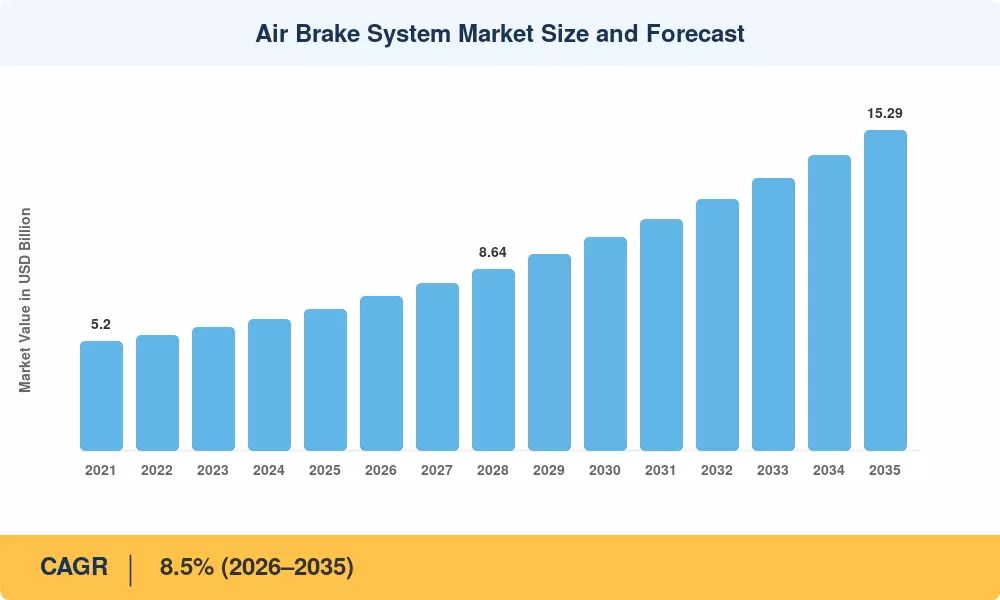
NEW YORK, NY, UNITED STATES, August 27, 2026 /EINPresswire.com/ — According to Market Research Future, the Air Brake System Market is projected to grow from USD 7.34 Billion in 2026 to USD 15.29 Billion by 2035, registering a CAGR of 8.5% during the forecast period 2026 to 2035, driven by integration of advanced sensor technologies enhances safety and efficiency. This substantial growth underscores the critical role air brake systems play in ensuring safety across commercial transportation, as regulatory standards tighten and vehicle manufacturers increasingly adopt electronic and sensor-based braking technologies.
Market Overview
Air brake systems are essential safety components used primarily in heavy commercial vehicles, buses, trains, and off-highway equipment. Unlike hydraulic braking systems, air brake systems utilize compressed air to transmit force from the brake pedal to the braking mechanism, offering superior stopping power, reliability, and fail-safe operation even in the event of pressure loss . These systems consist of compressors, storage tanks, valves, brake chambers, and increasingly sophisticated electronic control units that work together to deliver precise, responsive braking performance across demanding applications. The market is experiencing robust expansion as commercial vehicle production rises globally and safety regulations become more stringent across major economies.
The key growth drivers propelling this market expansion include the increasing adoption of advanced driver assistance systems (ADAS) and autonomous driving technologies, which demand higher-precision braking capabilities . Fleet operators are actively seeking total-cost-of-ownership reduction through conversion to air-disc brake systems, which offer better heat dissipation, shorter stopping distances, and reduced maintenance intervals compared to traditional drum brakes . The rising production of commercial vehicles, particularly in Asia Pacific, combined with growing infrastructure investments in railways and public transportation, is creating sustained demand for air brake systems .
The demand outlook for air brake systems remains exceptionally strong, driven by the convergence of regulatory pressure, technological advancement, and expanding commercial vehicle markets. The Automotive Braking System Market has seen parallel growth as the broader braking ecosystem evolves toward integrated, electronic, and software-defined solutions. Meanwhile, the Automotive Electronic Brake System Market is accelerating as vehicle manufacturers increasingly adopt electronically controlled braking architectures that offer superior safety, efficiency, and integration with ADAS functionalities. The growing demand for electric commercial vehicles is creating unique requirements for air brake systems, as battery-electric chassis must conserve auxiliary energy, making precision controllers that can trim air consumption by a significant margin increasingly valuable .
📍 Get Free Sample Report for Detailed Market Insights:
https://www.marketresearchfuture.com/sample_request/7204
Market Segmentation
The air brake system market is segmented based on brake type, vehicle type, component, and sales channel to provide comprehensive insights into the industry landscape.
By Brake Type: The market is categorized into Drum Air Brake, Disc Air Brake, Hybrid Drum-Disc Systems, and Electropneumatic Solutions. Drum air brakes retained a significant share of the market in 2025, reflecting their cost efficiency and widespread service familiarity across commercial vehicle segments . These systems remain popular due to lower upfront costs and extensive service network coverage, particularly in emerging markets. However, disc air brakes are penetrating the long-haul tractor segment following stricter stopping-distance regulations, offering superior heat dissipation, shorter stopping distances, and reduced brake fade during repeated heavy braking applications . Hybrid drum-disc configurations fill a transitional niche for fleets wanting disc performance on steer axles while relying on lower-maintenance drums on drive axles . Electropneumatic solutions, although representing a smaller fraction currently, are growing fastest as automatic emergency braking, lane-keeping, and platooning applications demand millisecond-level pressure modulation. These precision controllers can significantly reduce air consumption, drawing particular interest from battery-electric chassis applications where auxiliary energy conservation is critical . Disc brake advocates emphasize rotor offset designs and bolt-on caliper modules that accelerate pad swaps, claiming substantial labor reduction per wheel end compared to traditional drum configurations .
By Vehicle Type: The market serves Light Commercial Vehicles, Medium-Duty Trucks, Heavy-Duty Trucks, Buses & Coaches, and Off-Highway & Mining Trucks. Light commercial vehicles represented the largest segment in 2025, owing to urban delivery growth, especially across e-commerce corridors in Asia . Frequent stop-start duty cycles demand rapid pressure recovery, driving OEM preference for two-stage compressors paired with modular air-dryers . Heavy-duty trucks, though lower in unit sales, are forecast to expand at a robust CAGR, underpinned by zero-emission targets that obligate oil-free compressors, redundant ECUs, and high-accuracy pressure sensors . This segment also acts as an innovation incubator, with electric heavy-duty trucks adopting blended regenerative and friction braking, forcing suppliers to fine-tune air-pressure thresholds based on battery state of charge . Buses and coaches prioritize passenger comfort and safety, adopting electropneumatic logic that minimizes pitch during panic stops . Off-highway and mining haulers require high-capacity dual-circuit chambers rated beyond standard pressure levels, with sealed slack adjusters that withstand mud ingress and abrasive environments .
By Component: The market includes Compressor, Governor and Valves, Storage Tank, Brake Chambers & Actuators, and ECUs & Sensors. The compressor segment is expected to witness significant growth as manufacturers focus on lightweight and remanufactured compressor solutions, particularly for electric and hybrid vehicles that require oil-free compression technology . Brake linings, drums, and rotors represent a substantial share of the component market, supported by ongoing technological advancements in friction materials and heat dissipation designs . Electronic control units and sensors are becoming increasingly critical as braking systems evolve toward software-defined architectures that integrate with vehicle control networks . The growing sophistication of brake chambers and slack adjusters, including electronic slack-adjuster sensors, is expected to boost aftermarket revenue through data analytics capabilities that predict lining wear and optimize maintenance schedules .
By Sales Channel: The market is divided into OEM and Aftermarket channels. The OEM segment dominates, supported by collaborations between automakers and brake system suppliers that ensure integrated, validated braking solutions from the production stage . OEMs increasingly demand modular architectures that allow easier integration with vehicle control networks and faster validation cycles . The aftermarket segment is projected to grow significantly as commercial fleets and rail systems require increasing maintenance and component replacement. Component distributors and spare parts retailers that embrace digital channels and provide remote diagnostic support are earning stronger customer retention, while repair workshops that upskill for electronic system troubleshooting are capturing premium service revenues .
By Region: The market analysis covers North America, Europe, South America, Asia Pacific, and the Middle East and Africa, providing comprehensive geographic insights into regional dynamics and growth opportunities.
🛒 You can buy this market report at:
https://www.marketresearchfuture.com/checkout?currency=one_user-USD&report_id=7204
Regional Analysis
Asia Pacific emerges as the dominant and fastest-growing regional market, controlling a significant share of the global air brake system market in 2025 . China anchors the region with the world’s largest commercial vehicle production base, driven by massive e-commerce logistics, urban delivery growth, and expanding infrastructure development . India is gaining traction through the FAME scheme for electric buses, growing commercial vehicle production, and rising safety awareness across transport fleets. Japan and South Korea remain advanced markets with sophisticated vehicle electronics ecosystems, precision manufacturing capabilities, and high-reliance on quality braking systems for both domestic production and export markets . Broadening use-cases across every vehicle class ensure product portfolios remain modular, defending margins as the market diversifies by duty cycle and regulatory overlay .
Europe represents a mature and rapidly evolving market, shaped by ambitious decarbonisation targets, zero-emission transport regulations, and strong OEM leadership . Germany and the United Kingdom are expected to contribute significantly, supported by growing electric commercial vehicle development and stringent safety standards . The European Union’s safety regulations and commitment to reducing road fatalities are driving integration of advanced driver assistance systems and smart braking technologies. The region is also at the forefront of developing electropneumatic and software-defined braking solutions, with major suppliers investing in modular architectures that enable easier integration with vehicle control networks .
North America represents a key market for air brake systems, driven by strong freight transportation demand, high commercial vehicle adoption, and stringent safety regulations . The United States market is projected to reach substantial value, supported by innovative safety features driving air brake system adoption, rising demand for eco-friendly transportation solutions, and ongoing technological advancements enhancing brake efficiency . The National Highway Traffic Safety Administration’s stricter stopping-distance regulations have accelerated conversion from drum to disc brakes in long-haul tractors . Innovative safety features and fleet demand for total-cost-of-ownership reduction continue to boost adoption of advanced air brake technologies across North American commercial vehicle segments .
South America represents an emerging market with growing potential. Brazil and Mexico are spearheading early adoption, driven by expanding commercial vehicle production, improving economic conditions, and increasing safety awareness . Government engagements with development banks and climate funds are financing low-emission transit projects, creating demand for modern air brake systems in public transportation fleets. Despite infrastructure limitations, OEM partnerships and public-private partnership models are enabling steady growth as logistics and mass transit sectors expand .
The Middle East and Africa represent gradually developing markets exploring modern braking solutions. The UAE, Saudi Arabia, and South Africa are showing growing momentum in commercial vehicle fleet modernization and infrastructure development. Governments are piloting electric buses for urban transit and planning fleet modernization for logistics and municipal operations, creating opportunities for advanced air brake systems . While domestic manufacturing is limited, vehicle imports and partnerships with global OEMs are bridging technology gaps, laying the groundwork for future growth as public-private investments in infrastructure continue .
Competitive Landscape and Key Players
The air brake system market is highly competitive, featuring a mix of established global suppliers, specialized component manufacturers, and emerging technology providers. The competitive landscape is characterized by technological innovation, strategic partnerships, vertical integration, and geographic diversification.
Key players operating in this market include Knorr-Bremse AG, Wabtec Corporation, ZF Friedrichshafen AG, Meritor (Cummins Inc.), Haldex AB, Nabtesco Corporation, Continental AG, Brakes India Private Limited, SORL Auto Parts Inc., and WABCO . These industry leaders are investing heavily in research and development to create advanced air brake solutions that support electrification, autonomous driving, and connected fleet technologies.
Strategic developments are reshaping the competitive landscape. Leading suppliers are investing in modular architectures that allow easier integration with vehicle control networks and faster validation cycles, while technology specialists focus on sensor fidelity, software robustness, and cybersecurity for braking functions . Knorr-Bremse has expanded aftermarket revenue significantly in recent years, highlighting rising service demand and the growing importance of lifecycle service offerings . Meritor, now part of Cummins Inc., is focusing on sustainable brake solutions for heavy-duty vehicles, having launched energy-efficient air brake systems designed for electric and hybrid commercial vehicles . Strategic alliances and OEM-supplier collaboration are becoming more common as product complexity rises, with co-development agreements reducing time-to-market and improving system-level performance validation .
Innovation and technology initiatives are accelerating across the industry. Companies are developing smart braking solutions leveraging AI and IoT for predictive maintenance and performance optimization . The transition to electrified commercial vehicles is driving innovation in oil-free compressors, redundant ECUs, and high-accuracy pressure sensors that support blended regenerative and friction braking . Competitive differentiation increasingly depends on the ability to provide end-to-end solutions from hardware through software and service, rather than isolated component sales . Companies that demonstrate scalable firmware platforms, validated safety cases, and robust supply chain risk management are attracting investment, as these capabilities indicate readiness to support large fleets and cross-border deployments .
Latest Industry News and Developments
Recent industry developments highlight the dynamic nature of the air brake system market. In 2023, ZF Friedrichshafen announced plans to expand smart braking solutions leveraging AI and IoT for predictive braking systems, demonstrating the industry’s commitment to integrating advanced technologies into traditional braking architectures .
Meritor, following its acquisition by Cummins Inc., launched energy-efficient air brake systems specifically designed for electric and hybrid commercial vehicles, focusing on reducing vehicle weight and improving operational efficiency . This development underscores the industry’s response to the accelerating electrification of commercial transportation and the unique braking requirements of battery-electric and hybrid platforms.
Industry analysis suggests that by 2025, Wabco is expected to dominate the market with next-generation air brake systems that enhance both safety and fuel efficiency, reflecting the ongoing convergence of braking performance with broader vehicle efficiency and sustainability objectives . Major automotive companies including Aisin Seiki, Continental, Mando Corporation, and Knorr-Bremse are attracting significant investment in research and development to expand their product lines and address evolving market demands .
Market Challenges and Opportunities
The air brake system market faces several key challenges that could impact growth trajectories. High replacement costs of air brake components may restrain market expansion, as commercial fleet operators often operate under tight budgets . Replacement costs for components such as calipers, rotors, and brake pads can significantly increase operating expenses, potentially delaying maintenance cycles and impacting aftermarket demand . The growing count of electronically modulated valves and sensors raises workshop bills, especially in fleets that lack calibrated diagnostic tools, while higher-specification materials and firmware licensing fees add recurring costs that may temper near-term growth .
Supply chain disruptions and raw material price volatility pose ongoing challenges, with geopolitical tensions, export controls, and mining permit timelines introducing uncertainty that complicates OEM cost planning and manufacturing strategies . The complexity of integrating multiple electronic components, software platforms, and connectivity solutions requires substantial investment in R&D and engineering resources. Cybersecurity concerns associated with electronic braking systems require robust protection measures to maintain safety and reliability . Variance in regulatory regimes across countries complicates global rollouts, while some regions lack supporting infrastructure for advanced braking technologies.
To explore more market insights, visit us at:
https://www.marketresearchfuture.com/reports/air-brake-system-market-7204
Final Market Summary
The transformation from traditional pneumatic braking to software-defined, electronically controlled systems represents a fundamental industry evolution, positioning air brake system providers as essential partners in the broader automotive technology ecosystem. As vehicles become increasingly connected, electric, and autonomous, the role of air brake systems will continue to expand, ensuring sustained relevance and innovation throughout the forecast period and beyond.
More Related Reports from MRFR Library:
Commercial Vehicle Wiring Harnes Market : https://www.marketresearchfuture.com/reports/commercial-vehicle-wiring-harnes-market-31045
Truck Clutch Market : https://www.marketresearchfuture.com/reports/truck-clutch-market-31147
Automotive 3D Map System Market : https://www.marketresearchfuture.com/reports/automotive-3d-map-system-market-31153
Automotive Cylinder Liner Market : https://www.marketresearchfuture.com/reports/automotive-cylinder-liner-market-31297
Automotive Emc Market : https://www.marketresearchfuture.com/reports/automotive-emc-market-31303
Automotive Rebuilt Engines Market : https://www.marketresearchfuture.com/reports/automotive-rebuilt-engines-market-31388
Automotive Remanufacturing Market : https://www.marketresearchfuture.com/reports/automotive-remanufacturing-market-31389
Used EV Market : https://www.marketresearchfuture.com/reports/used-ev-market-31422
Driver Monitoring System Market : https://www.marketresearchfuture.com/reports/driver-monitoring-system-market-31505
Electric Vehicle Busbar Market : https://www.marketresearchfuture.com/reports/electric-vehicle-busbar-market-31746
Market Research Future
Market Research Future
+1 855-661-4441
email us here
Legal Disclaimer:
EIN Presswire provides this news content “as is” without warranty of any kind. We do not accept any responsibility or liability
for the accuracy, content, images, videos, licenses, completeness, legality, or reliability of the information contained in this
article. If you have any complaints or copyright issues related to this article, kindly contact the author above.

Media gallery