What it means to be “truly American” divides AAPIs and the U.S. public, new survey finds
PR Newswire
SAN FRANCISCO, May 1, 2026
Ahead of America’s 250th anniversary, a study from The Asian American Foundation conducted by NORC finds a country split over identity, belonging, and who gets to call themselves American.
SAN FRANCISCO, May 1, 2026 /PRNewswire/ — As the United States approaches its 250th anniversary, The Asian American Foundation (TAAF) today released new research revealing the country is sharply divided over a fundamental question: what does it mean to be truly American?
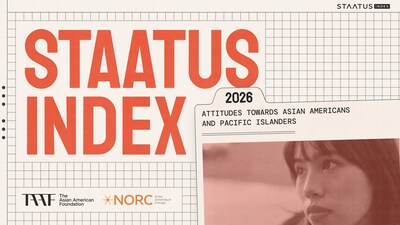
According to TAAF’s sixth annual Social Tracking of Asian Americans in the U.S. (STAATUS) Index, conducted by NORC at the University of Chicago, half of U.S. adults (50%) say being born in the United States is important to being “truly American.” By contrast, 77% of Asian Americans and Pacific Islanders (AAPIs) say it is not, a higher share than any other racial or ethnic group.
The 2026 STAATUS Index, the leading national study of Americans’ perceptions of AAPIs, also finds widespread uncertainty about the place of the nation’s 25 million AAPIs, revealing stark gaps in how U.S. adults think about the impact of federal policies on Asian Americans and the growing cultural influence of AAPIs. As millions prepare to celebrate AAPI Heritage Month in May, the survey also shows AAPIs are anxious amid mounting federal crackdowns on immigration, trade wars, safety concerns, and other pressures.
“The latest STAATUS Index provides our clearest look yet at the disconnect between how AAPIs experience life and how the rest of the country perceives us,” said Norman Chen, CEO of TAAF. “Despite our community’s growing power, a significant share of the public is still forming views about America’s fastest-growing racial group with no direct connection or information. This helps to explain the perception gaps that run throughout this report, and has real consequences for our community’s future.”
This year, TAAF partnered with NORC at the University of Chicago, one of the nation’s most trusted independent research institutions, on the 2026 STAATUS Index. Building on five years of research, the study brings an evolved methodology and expanded focus on policy and current events, developed with input from a committee of leading scholars.
“The 2026 STAATUS Index offers a rigorous, nationally representative view of how adults across the United States think about identity and belonging,” said Alex Chew, AmeriSpeak Director at NORC and head of Amplify AAPI. “The findings show that limited contact and historical understanding can lead to differences in how Asian Americans are viewed.”
Key findings from the 2026 STAATUS Index include:
- The U.S. public is divided over who counts as “truly American.” As the Supreme Court weighs challenges to birthright citizenship, half of U.S. adults say being born in the U.S. is important to being truly American, while 77% of AAPIs say it is not. AAPIs are also more likely than other groups to rate being white (93%) or being a Christian (84%) as unimportant to American identity.
- Worry is more top of mind for AAPIs than for other groups. When asked how they feel about life right now, Americans overall most often say hopeful (48%), including white (50%), Black (53%), and Hispanic (44%) adults. AAPIs are the only racial or ethnic group for whom worry (44%) outranks hope (40%).
- From tariffs to student visa restrictions to immigration enforcement, AAPIs are more likely than the general public to say recent federal policy changes have hurt Asian American communities. Nearly three quarters of AAPIs (71%) say tariffs on goods imported from countries like China or India have negatively impacted Asian American communities, compared with 47% of U.S. adults overall. AAPIs are also more likely than the general public to express distrust in ICE’s ability to enforce immigration laws fairly and safely in their communities (61% vs. 51%).
- Many Americans are forming views of AAPIs without any direct connection or information. More than 1 in 4 U.S. adults (26%) report having none of seven common types of relationships with an Asian American, including a friend, neighbor, or co-worker. Nearly 1 in 3 (31%) say they receive no information about AAPI communities at all.
- Just 7% of U.S. adults believe AAPI communities have “a great deal” of influence on U.S. culture. Gen Zers (18-24) are somewhat more likely than older Americans (50+) to share that view, though differences are modest (11% vs. 4%). But perceptions may be shifting, with nearly 1 in 3 (32%) Americans perceiving AAPIs as having gained influence in the last five years. AAPIs themselves are more likely than other racial and ethnic groups to perceive their own group as having gained influence in that time (50%).
- Amid rollbacks of DEI initiatives across the country, AAPIs are the most likely of all racial and ethnic groups to express support for DEI generally, with two-thirds (66%) of AAPI adults expressing support compared to 48% of U.S. adults overall.
- Views of AAPI status differ sharply by race and ethnicity. White Americans see the status of Asian Americans in U.S. society as more similar to white people (64%) than to people of color (31%), but most AAPI, Black, and Hispanic adults disagree. Nearly 3 in 4 AAPIs (74%) see the status of their own racial group as more similar to people of color than to white people.
- 1 in 5 U.S. adults are concerned that Chinese Americans pose a threat to U.S. society. Yet Americans appear persuadable on key policy choices, including the U.S. government’s previously announced plans to revoke visas for some Chinese students, and most are ambivalent (27%) or opposed (38%) to land laws preventing Chinese citizens who reside in the U.S. from purchasing land.
- Safety challenges remain years after the rise in anti-Asian violence during the pandemic. 1 in 5 AAPI adults report being harassed, threatened, or insulted because of their race or ethnicity in the last 12 months.
- Americans want to know more about AAPIs. They just have not had the chance yet. More than half of Americans (53%) cannot name a single significant event in Asian American history. Yet Americans point to concrete ways they are willing to engage: school and community programs that promote understanding of AAPI culture (43%) and films and TV that authentically portray AAPI experiences (37%) top the list of solutions Americans say they would support.
Additional findings and data are available in the full report at share.taaf.org/STAATUS2026.
The 2026 STAATUS Index study was conducted by NORC at the University of Chicago on behalf of The Asian American Foundation using NORC’s AmeriSpeak® Panel and NORC’s Amplify AAPI Panel. Both panels are probability-based panels, and the Amplify AAPI panel was used to fill the quota for the AAPI oversample. The STAATUS Index survey was offered in English-only and was conducted with respondents online. 1,778 U.S. adults participated from January 16, 2026 – February 10, 2026. The margin of sampling error is +/- 3.17 percentage points.
About the STAATUS Index
The STAATUS Index—Social Tracking of Asian Americans in the U.S.—is a comprehensive, annual assessment of stereotypes and attitudes towards Asian Americans, Native Hawaiians, and Pacific Islanders. The inaugural 2021 STAATUS Index was one of the first national studies on this topic in 20 years. Conducted annually, the survey tracks trends in whether and how long-held stereotypes and current events may influence American sentiment.
About The Asian American Foundation (TAAF)
TAAF serves the Asian American and Pacific Islander (AAPI) community by promoting safety, fostering belonging, and advancing prosperity. Launched in 2021 in response to the rise in anti-Asian hate and to address the long-standing underinvestment in AAPI communities, we invest in initiatives to combat anti-Asian hate, integrate AAPI studies into school curricula, elevate authentic AAPI storytelling, and expand resources and representation for our communities. Through our high-impact initiatives, events, and investments in national and local nonprofits, we’re creating a permanent and irrevocable sense of belonging for millions of AAPIs in the United States. For additional information about TAAF, please visit www.taaf.org or follow @TAAForg on Instagram, LinkedIn, TikTok, or Facebook.
About NORC at the University of Chicago
NORC at the University of Chicago conducts research and analysis that decision-makers trust. As a nonpartisan research organization and a pioneer in measuring and understanding the world, NORC has studied almost every aspect of the human experience and every major news event for more than eight decades. Today, NORC partners with government, corporate, and nonprofit clients around the world to provide the objectivity and expertise necessary to inform the critical decisions facing society.
MEDIA CONTACT
press@taaf.org
 View original content to download multimedia:https://www.prnewswire.com/news-releases/what-it-means-to-be-truly-american-divides-aapis-and-the-us-public-new-survey-finds-302759027.html
SOURCE The Asian American Foundation


