Commercial Security Market Size, Share and Research Report By Product (Smart Locks, Security Cameras, and Sensors), By Type (Intruder Alarms, Software)
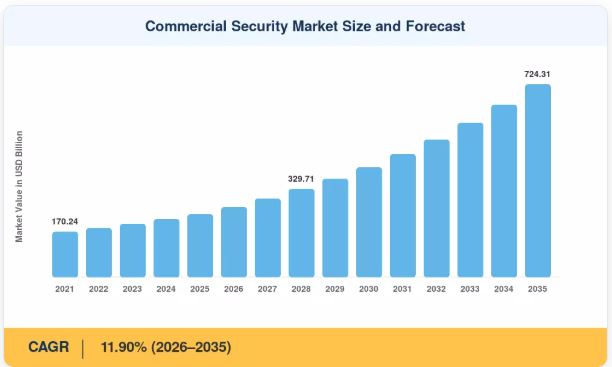
NEW YORK,, NY, UNITED STATES, September 21, 2026 /EINPresswire.com/ — The Global Commercial Security market reached USD 235.31 billion in 2025 and is projected to grow from USD 263.32 billion in 2026 to USD 724.31 billion by 2035, registering an 11.90% CAGR during the forecast period 2026-2035. Regulatory mandates such as Alyssa’s Law in the United States and the EU’s revised Critical Entities Resilience Directive have pushed organisations to adopt multi-layered protection platforms that combine sensors, analytics, and communication in a single pane of glass.
Capital spending on physical-security infrastructure exceeded USD 48 billion in the U.S. alone during 2024, signalling a clear purchasing commitment from both public and private sectors. The market’s 11.90% CAGR reflects the convergence of AI-driven analytics and autonomous response (2.4% impact), regulatory mandates including Alyssa’s Law and NIS2 (2.1% impact), smart-city infrastructure programmes (1.7% impact), and cloud-native VSaaS cost reduction (1.8% impact) accelerating across the world’s largest regulatory-compliance and urbanisation economies simultaneously.
The Commercial Security Market is becoming increasingly important as businesses, institutions, and commercial facilities face growing concerns related to theft, unauthorized access, workplace safety, cyber threats, and operational disruptions. Modern commercial security solutions are moving beyond traditional alarms and surveillance cameras toward intelligent, connected, and automated systems that combine video surveillance, access control, intrusion detection, analytics, and remote monitoring.
Get Full PDF Sample Copy of Report: (Including Full TOC, List of Tables & Figures, Chart) @
https://www.marketresearchfuture.com/sample_request/2861
➤ Key Market Drivers:
Rising Security Threats: Increasing incidents of theft, vandalism, unauthorized access, fraud, workplace violence, and property damage are encouraging organizations to strengthen their security infrastructure. Businesses are increasingly investing in preventive technologies that can identify suspicious activity before it develops into a major incident.
Adoption of Artificial Intelligence: Artificial intelligence is one of the strongest technology drivers in the commercial security industry. AI-powered systems can analyze video feeds, identify unusual behavior, detect unauthorized movement, recognize specific objects, and generate alerts based on predefined conditions.
Instead of requiring security personnel to continuously monitor hundreds of camera feeds, intelligent analytics can prioritize potentially important events. This improves response times while reducing the burden on security teams.
Growth of Cloud-Based Security: Cloud platforms are changing how commercial security systems are deployed and managed. Businesses can remotely access cameras, access-control systems, alerts, and security data through centralized platforms.
Cloud-based solutions are particularly useful for companies operating multiple offices, retail stores, warehouses, branches, or other geographically distributed facilities.
Smart Building Development: The expansion of smart commercial buildings is creating greater demand for connected security systems. Access control, surveillance, alarms, sensors, visitor management, and building automation can increasingly work together through integrated platforms. This integration allows organizations to improve both security and operational efficiency.
Increasing Demand for Remote Monitoring: Remote security monitoring enables organizations to supervise facilities without maintaining a large security team at every location. Security operators can monitor multiple sites, receive alerts, verify incidents, and coordinate responses from centralized locations.
This model is especially valuable for businesses with distributed facilities and limited security resources.
➤ What Does the Future Hold for the Commercial Security Market?
AI-driven analytics and autonomous response contribute approximately 2.4 percentage points to the commercial security market’s CAGR the single highest driver impact. Object-classification algorithms embedded in edge cameras can now distinguish between a delivery drone and a perimeter breach, transforming surveillance from a passive recording function into an active threat-response layer. Commercial campuses deploying AI-analytic overlays reported a 34% reduction in false-alarm dispatches during pilot programmes in Chicago and London, directly lowering operational costs for central monitoring stations.
Regulatory mandates including Alyssa’s Law and NIS2 contribute approximately 2.1 percentage points of driver impact, establishing compliance as a primary structural driver. Alyssa’s Law, originally enacted in New Jersey and now adopted in eight states, requires K-12 schools and certain commercial facilities to install silent-panic-alarm systems linked directly to law enforcement dispatch centres. In Europe, the NIS2 Directive extended cybersecurity obligations to physical-security operators, compelling building managers to upgrade legacy access panels that lack encrypted communication protocols.
Smart-city infrastructure programmes add a further 1.7% as comparable programmes in Saudi Arabia’s NEOM, Egypt’s New Administrative Capital, and Indonesia’s Nusantara create greenfield deployment opportunities in regions where legacy installed base is minimal. Cloud-native VSaaS cost reduction contributes a further 1.8% as VSaaS eliminates the need for on-premises NVR hardware, moving the cost structure from a large upfront capital expense to a predictable monthly recurring expense; Eagle Eye Networks found that multi-site retailers who adopted VSaaS cut their three-year total cost of ownership by 28% compared to traditional architectures, expanding the addressable base to include small and mid-sized businesses, franchises, and co-working spaces that previously found enterprise-grade monitoring prohibitive.
The next phase of the market’s evolution centers on AI-autonomous security operations, as the market increasingly rewards vendors that can deliver closed-loop workflows, detect, verify, escalate, and resolve, within a single platform; edge-AI chipsets from Qualcomm and Ambarella are already enabling camera-level decision-making at under 200 milliseconds latency.
Platform economics and recurring revenue are reshaping the competitive landscape, mirroring the SaaS transformation that reshaped enterprise IT over the past decade, with Genetec, Verkada, and Rhombus Networks pioneering subscription models where cameras arrive pre-provisioned and tenants pay per-door or per-camera monthly fees, compressing gross margins on hardware while expanding lifetime customer value.
Sustainability and ESG-aligned security infrastructure is also gaining weight as building owners pursuing LEED Platinum and BREEAM Outstanding ratings select security hardware that meets energy-efficiency benchmarks, such as PoE cameras consuming under 12 watts, with the World Green Building Council estimating that smart-building integrations including security can reduce operational energy use by 18%.
Post-quantum cryptographic standards from NIST will require credential issuers and access-control manufacturers to upgrade encryption protocols by approximately 2030, positioning early movers that embed lattice-based cryptography into smart cards and mobile credentials for differentiation advantage as government facilities begin mandating quantum-resilient access architectures.
Get access to the full description of the report @
https://www.marketresearchfuture.com/reports/commercial-security-market-2861
➤ Who Are the Key Players in the Commercial Security Market?
The commercial security market exhibits low-to-moderate concentration, with the top five vendors holding an estimated 28-34% combined revenue share. The competitive field spans multinational conglomerates with broad building-technology portfolios, specialised camera manufacturers, and software-centric disruptors. Mergers and acquisitions remain frequent; large players use tuck-in deals to fill analytics or cloud-platform gaps, while private-equity firms roll up regional integrators to build national service footprints. MRFR identifies the following key participants with estimated revenue share ranges:
• Honeywell International (~7–10% share
• Johnson Controls International (~6–9% share)
• Robert Bosch GmbH (~5–8% share)
• Hikvision Digital Technology (~6–9% share)
• Motorola Solutions / Avigilon (~4–6% share)
• Axis Communications / Canon Group (~3–5% share)
• Dahua Technology (~4–7% share)
• ASSA ABLOY (~3–5% share)
• ADT Inc. (~3–5% share)
• Genetec Inc. (~2–4% share)
Strategic competition in the commercial security market is increasingly defined by cloud-platform economics and closed-loop AI workflows rather than hardware volume alone, with data-privacy regulations limiting video retention cited as a top structural headwind, contributing an estimated -1.4% drag on CAGR as the EU’s GDPR and emerging U.S.
state-level biometric-privacy statutes such as Illinois BIPA and Texas CUBI impose strict consent and retention obligations that have delayed several multinational retailers’ analytics rollouts, alongside high upfront cost of integrated platforms exceeding USD 250,000 per site in mid-sized commercial buildings, cybersecurity vulnerabilities in IoT devices, a skilled-labour shortage for installation and maintenance, and geopolitical restrictions on Chinese-origin equipment under NDAA Section 889.
➤ What Are the Emerging Trends in the Commercial Security Market?
Several transformational trends are redefining the commercial security market’s evolution through 2035:
Managed Security Services for SMEs: Small and mid-sized enterprises represent just 23.7% of current market revenue but employ more than 60% of the global workforce, and subscription-based monitoring platforms priced at USD 150-500 per month per site can unlock a TAM exceeding USD 90 billion by 2032.
Physical-Cyber Convergence Platforms: Enterprises that unify badge-access logs, network-authentication events, and camera feeds into a single security-operations centre can correlate insider-threat indicators that neither physical nor IT security teams catch in isolation.
Smart-City and Safe-City Programmes in Emerging Markets: Comparable programmes in Saudi Arabia’s NEOM, Egypt’s New Administrative Capital, and Indonesia’s Nusantara create greenfield deployment opportunities in regions where legacy installed base is minimal.
Data Monetisation Through Occupancy Analytics: Commercial landlords are learning that anonymized foot-traffic and space-utilisation data from security cameras can be re-packaged as tenant-experience insights, moving the value proposition from cost avoidance to revenue generation.
Drone-Based Perimeter Surveillance: Autonomous interior and outdoor patrol drones with thermal imaging can cover big distribution centers and solar farms at a tenth of the cost of manned guard rotations, with the worldwide security-drone segment expected to approach USD 4.8 billion by 2030.
Buy Full Research Report:
https://www.marketresearchfuture.com/checkout?currency=one_user-USD&report_id=2861
➤ How Is the Commercial Security Market Segmented?
The commercial security market report provides a comprehensive segmentation framework:
By Security Type: Video Surveillance (48.5% share, 2025), Access Control (12.15% CAGR), Fire Protection Systems (USD 42.18 billion, 2025), Intrusion Detection (10.84% CAGR), Others — Intercoms, Mass Notification (USD 11.42 billion, 2025)
By Component: Hardware (71.5% share, 2025), Services (12.57% CAGR), Software (USD 24.38 billion, 2025)
By End-User Industry: Commercial Offices (25.9% share, 2025), Healthcare Facilities (12.27% CAGR), Retail (USD 33.74 billion, 2025), Banking & Financial Services (10.68% CAGR), Education (USD 16.92 billion, 2025), Others — Logistics, Hospitality, Industrial (22.1% share, 2025)
By Organisation Size: Large Enterprises (76.3% share, 2025), SMEs (12.80% CAGR)
By Product: Smart Locks, Security Cameras, and Sensors
By Region: North America (36.1% share, 2025), Europe (26.8% share, 2025), Asia-Pacific (11.83% CAGR), South America (USD 19.30 billion, 2025), Middle East & Africa (6.5% share, 2025)
➤ What Are the Regional Insights from the Commercial Security Market?
The commercial security market exhibits significant regional variation driven by regulatory maturity, urbanisation rates, and insurance-market sophistication. North America commanded a 36.1% share in 2025, with the United States accounting for 78.4% of regional share as federal buildings, K-12 schools, and healthcare campuses represent the three highest-growth verticals through Alyssa’s Law and NDAA compliance.
Europe’s commercial security market, holding a 26.8% share in 2025, is shaped by the twin forces of counter-terrorism legislation and data-privacy regulation. Germany commands 22.3% of regional share through Industry 4.0 facility protection and NIS2 early adoption, the UK is growing at a 10.94% CAGR as Martyn’s Law, expected to reach royal assent by 2026, will mandate threat assessments and protective security measures for all public venues with a capacity exceeding 100.
Asia-Pacific is the fastest-growing region in the commercial security market at an 11.83% CAGR, with India emerging as the standout opportunity. China commands 34.6% of regional share through safe-city programmes and domestic manufacturing scale, India is posting a 13.18% CAGR within the region as its National Crime Records Bureau integration programme and mandatory CCTV requirements for new commercial construction permits in Delhi, Mumbai, and Bengaluru drive double-digit annual growth through 2030.
Brazil’s central bank requires all financial institutions to maintain auditable video records of branch transactions, a regulation that has sustained camera-upgrade spending even during economic contractions, commanding 58.3% of South American regional share in the commercial security market.
Argentina is growing at a 10.16% CAGR through retail-sector expansion and public-space monitoring, and the rest of South America contributed USD 3.88 billion through mining-facility protection and infrastructure development, with São Paulo and Bogotá each investing over USD 200 million in networked surveillance during 2023-2025 through municipal safe-city contracts.
Saudi Arabia’s Vision 2030 mega-projects, including NEOM, The Line, and the Red Sea tourism development, are generating multi-billion-dollar security tenders that blend perimeter surveillance, access management, and fire-life-safety systems into single integrated procurements, commanding 28.7% of Middle East & Africa regional share, which held a 6.5% global share in 2025.
➤ Frequently Asked Questions:
1. What is the Commercial Security Market?
The Commercial Security Market includes technologies, products, software, and services used to protect commercial buildings, employees, customers, equipment, information, and other assets from security threats.
2. What are the major commercial security technologies?
Major technologies include video surveillance, access control, intrusion detection, alarms, fire protection, biometric systems, security analytics, sensors, and centralized monitoring platforms.
3. Why is AI important for commercial security?
AI can analyze large amounts of security data, identify unusual activity, automate alerts, improve surveillance accuracy, and help security teams respond more quickly to potential threats.
➤➤➤ Regional & Country-Level Reports by Market Research Future:
US Commercial Security Market –
https://www.marketresearchfuture.com/reports/us-commercial-security-market-15791
➤➤ Industry Analysis Reports by Market Research Future:
Hardware Security Modules Market
https://www.marketresearchfuture.com/reports/hardware-security-modules-market-2410
Cloud Security Market
https://www.marketresearchfuture.com/reports/cloud-security-market-2121
Wireless Security System Market
https://www.marketresearchfuture.com/reports/wireless-security-system-market-2788
Network Security Appliance Market
https://www.marketresearchfuture.com/reports/network-security-appliance-market-7054
Security Screening Market
https://www.marketresearchfuture.com/reports/security-screening-market-22130
Bfsi Security Market
https://www.marketresearchfuture.com/reports/bfsi-security-market-1810
Debt Security Market
https://www.marketresearchfuture.com/reports/debt-security-market-22786
Digital Security Control Market
https://www.marketresearchfuture.com/reports/digital-security-control-market-30069
Cloud Security Consulting Services Market
https://www.marketresearchfuture.com/reports/cloud-security-consulting-services-market-66221
Cybersecurity Risk Assessment Consulting Services Market
https://www.marketresearchfuture.com/reports/cybersecurity-risk-assessment-consulting-services-market-66438
Market Research Future
Market Research Future
+1 855-661-4441
email us here
Legal Disclaimer:
EIN Presswire provides this news content “as is” without warranty of any kind. We do not accept any responsibility or liability
for the accuracy, content, images, videos, licenses, completeness, legality, or reliability of the information contained in this
article. If you have any complaints or copyright issues related to this article, kindly contact the author above.

Media gallery